 Blog
Fabiana Teixeira
Technology at What Cost? The Socio-Environmental Impacts of AI Infrastructure in Northeastern Brazil
The expansion of artificial intelligence (AI) infrastructure has raised concerns within the scientific community: technological development is accelerating without the legislative safeguards necessary to mitigate its associated socio-environmental impacts. According to Data Center Map, at least 224 data centers are listed as operating in Brazil, with the state of Ceará ranking third in terms of the number of facilities [1]. However, projections indicate that Northeastern Brazil is expected to attract 30% of investments in new hyperscale data center installations [2] [3].
Due to its abundance of renewable energy sources and strategic geographical location, with submarine fiber-optic cable landing points distributed throughout the region, Northeastern Brazil has established itself as a major data center hub. In this context, Redata (Special Tax Regime for Data Center Services) provides tax incentives to encourage projects involving the installation of AI infrastructure in Brazil.
Among the socio-environmental costs associated with AI service infrastructure, the following stand out: 1) consumption of non-renewable energy; 2) carbon emissions and greenhouse gas emissions; 3) water scarcity; 4) electronic waste disposal; 5) exploitation of precious mineral resources; and 6) exposure of local communities and traditional peoples to conditions of socio-environmental injustice.
Socio-Environmental Costs: Northeastern Brazil as a Sacrifice Zone
Northeastern Brazil has gained prominence in the AI landscape, attracting global interest in the construction of hyperscale data centers throughout the region, particularly due to the availability of renewable energy sources. Nevertheless, environmental and social costs remain a peripheral concern in discussions of technological innovation, perpetuating a structure of environmental opacity aimed at concealing the costs associated with AI infrastructure through a lack of transparency regarding the different stages of its life cycle.
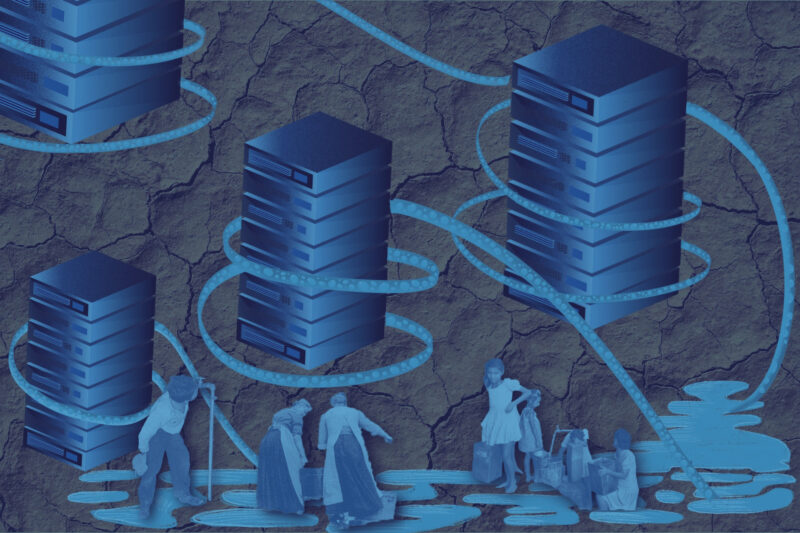
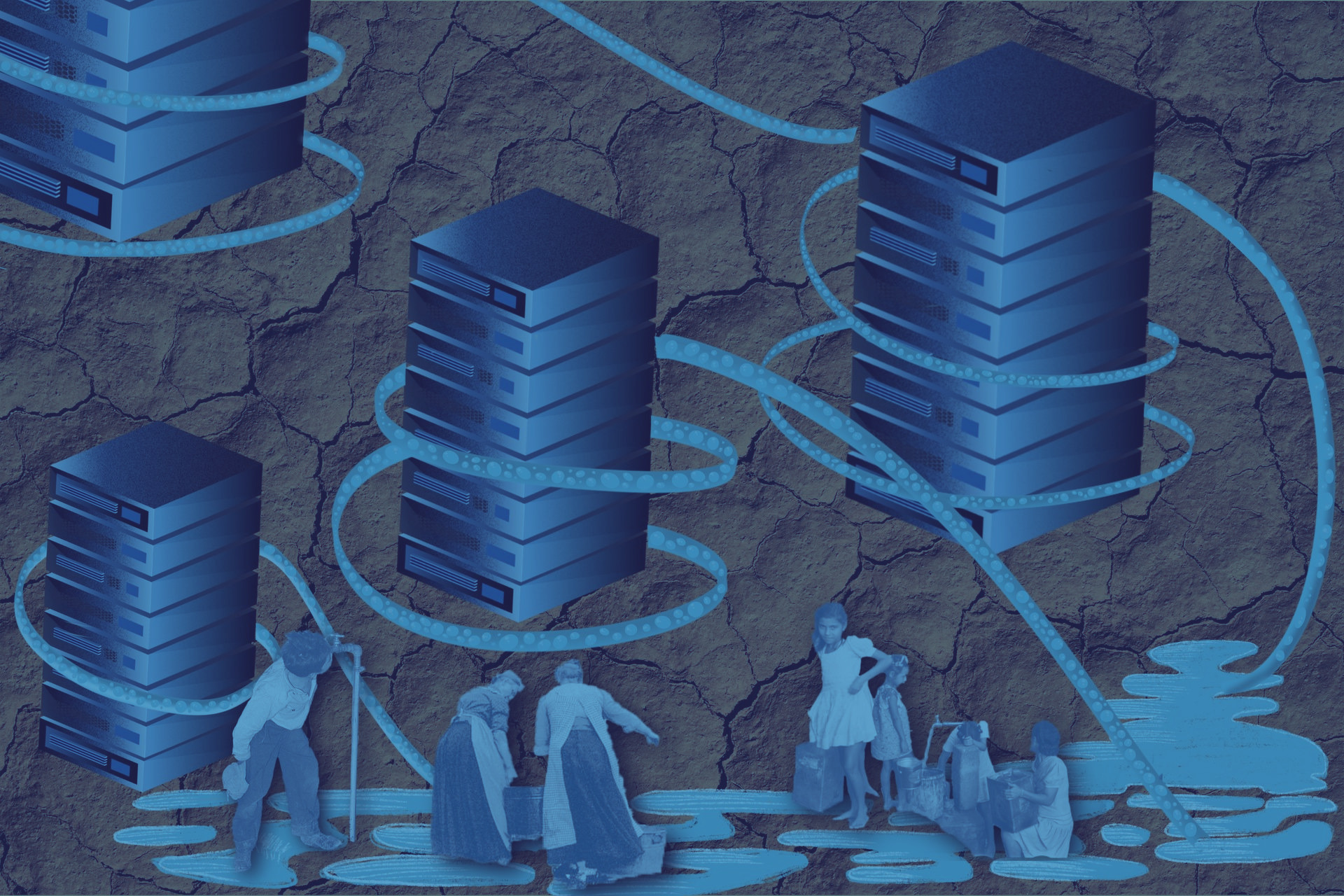
In this context, technological development in Brazil is marked by significant social inequalities. Foreign companies invest in the country’s physical AI infrastructure, while the states of Northeastern Brazil are becoming actual sacrifice zones [4]: local populations living in nearby areas face water scarcity, toxic waste disposal, and risks associated with air pollution resulting from carbon emissions. Furthermore, the excessive energy consumption of these facilities also has significant impacts on nearby residents [5].
Characterized by prolonged droughts, recurring extreme weather events, and a semi-arid climate, the region is particularly susceptible to socio-environmental disasters and has historically been vulnerable to conditions of socio-environmental and climate injustice [6]. In this regard, the accelerated implementation of data centers, considering the impacts associated with their construction and operation, may intensify pre-existing inequalities, deepen local conflicts, and irreversibly affect ecosystem balance [7].
As previously mentioned, the state of Ceará ranks third in terms of the number of data centers in Brazil, behind only São Paulo and Rio de Janeiro. In addition to those already operating, the municipality of Caucaia has also attracted international interest for several new projects, including the proposed installation of Latin America’s largest data center by ByteDance, the company behind TikTok. However, local residents and leaders of nearby Indigenous communities have expressed concern following the announcement, given that they already face daily water and energy insecurity, and the installation of a hyperscale data center could further intensify these conditions [8].
Thus, AI infrastructure entails significant environmental burdens throughout its entire life cycle, which cannot be overlooked. Even when companies rely on renewable energy sources under the promise of carbon neutrality, this does not necessarily guarantee that the energy used is environmentally clean. After all, during periods of drought or shortages of renewable energy due to climate instability in Northeastern Brazil, data centers depend on thermoelectric power plants to maintain their operations, which, in turn, rely on fossil fuel sources [9].
Redata and Digital Colonialism
It is important to highlight that the strategic presence of submarine fiber-optic cables, the potential for renewable energy generation, and the absence of specific environmental regulations for data centers are attracting factors for foreign investment in the construction of these facilities in Brazil. In addition, the tax incentives offered through Redata further contribute to attracting the interest of major corporations. However, public discourse surrounding technological innovation does not prioritize the existing dynamics of socio-environmental and climate injustice in Northeastern Brazil, which may be significantly exacerbated by the impacts associated with AI’s life cycle.
While the region bears a significant environmental burden, the economic returns are not necessarily proportional to the negative impacts. Local populations, including Indigenous communities and other nearby residents, bear the greatest consequences of high levels of energy and water consumption and carbon emissions, while no economic returns for the local economy are guaranteed. This reinforces a colonial structure in which countries in the Global South bear the environmental costs of meeting foreign technological demands, while external actors exploit our natural resources and renewable energy sources [10].
Without effective proposals to mitigate the environmental risks associated with AI infrastructure and guarantees of social and economic development that benefit the region, technological innovation becomes nothing more than a justification for concealing the underlying objective of capital accumulation by major corporations, with economic value added concentrated abroad and environmental costs concentrated within our territory. Thus, a region historically vulnerable to socio-environmental injustices and environmental disasters becomes a technological hub without meaningful discussion of water and energy scarcity, electronic waste disposal, carbon and greenhouse gas emissions, or the burdens imposed on people living in the surrounding areas.
Beyond Technological Innovation: Pathways Towards Sustainable AI
Therefore, it is necessary to consider possible mechanisms for reducing the environmental costs associated with AI infrastructure. To this end, we draw on the insights presented in Towards Sustainable AI: A Comprehensive Framework for Green AI [11] and Sustainable AI: Environmental Implications, Challenges and Opportunities [12].
The use of renewable energy sources alone does not make AI infrastructure sustainable. The development and exploitation of renewable energy can also generate significant impacts on the environment and local communities, including water scarcity, greenhouse gas emissions, and improper electronic waste disposal, repeatedly exposing these populations to conditions of socio-environmental injustice. In this regard, the studies by Tabbakh et al. and Wu et al. present proposals to mitigate the impacts associated with AI’s physical infrastructure. These include:
- Model optimization, aimed at reducing the number of operations, memory requirements, and computational resources needed to run AI models. Techniques such as Model Pruning, which involves removing redundant components from a model, thereby reducing its size and computational requirements, and Quantization, which involves reducing the numerical precision of model parameters, resulting in smaller models, faster computation, and improved energy efficiency, can be employed [13].
- Extending hardware lifespan, with the aim of reducing equipment replacement and premature disposal, consequently minimizing electronic waste generation.
- Adopting smaller models (small models), which can meet less demanding computational needs while requiring fewer resources, thereby significantly reducing the environmental impacts associated with large-scale data centers.
- Establishing transparency and monitoring requirements to assess the socio-environmental impacts associated with AI infrastructure, including the adoption of environmental sustainability metrics and environmental impact reports.
Therefore, technological development projects in Northeastern Brazil cannot be dissociated from discussions concerning the socio-environmental impacts resulting from the implementation of data centers. After all, achieving development aligned with the United Nations Sustainable Development Goals (SDGs) [14] requires technological infrastructure expansion to take environmental constraints and the preservation of natural resources into account, while ensuring socio-environmental justice and preventing the intensification of pre-existing inequalities and vulnerabilities.
References
[1] Data Center Map. Brazil Data Centers. 2026. https://www.datacentermap.com/brazil/.
[2] VILLARROEL, Rafael. Sob alta demanda, Nordeste avança como polo de data centers. CNN Brasil, São Paulo, 16 out. 2026. https://www.cnnbrasil.com.br/infra/sob-alta-demanda-nordeste-avanca-como-polo-de-data-centers/
[3] O que é um data center em hiperescala? Disponível em: https://www.ibm.com/br-pt/think/topics/hyperscale-data-center
[4] KNOX, Winifred; FERREIRA, José Gomes. Desastre ambiental e zonas de sacrifício: o derramamento de petróleo no Nordeste do Brasil e políticas públicas de Estado. Revista da ANPEGE, v. 18 n. 37, p. 89-105, (2022). https://doi.org/10.5418/ra2022.v18i37.16273
[5] MARTINS, Laís; CHIAVERINI, Tomás. Moradores se unem para barrar data center do TikTok no Ceará. The Intercept Brasil, 17 set. 2025. Disponível em: https://www.intercept.com.br/2025/09/17/moradores-se-mobilizam-contra-data-center-tiktok-ceara/.
[6] TEIXEIRA, Rylanneive Leonardo Pontes et al. Desastres socioambientais e injustiças climáticas no Nordeste do Brasil. Revista de Desenvolvimento Regional, v. 22 n. 1, jan./mar. (2025). https://doi.org/10.26767/coloquio.222025.3603.
[7] FERNANDES, André Lucas et al. IA, data centers e os impactos ambientais. Instituto de Pesquisa em Direito e Tecnologia do Recife (IP.rec), 2025. Disponível em: https://ip.rec.br/publicacoes/ia-data-centers-e-os-impactos-ambientais/.
[8] MARTINS, Laís; CHIAVERINI, Tomás. Moradores se unem para barrar data center do TikTok no Ceará. The Intercept Brasil, 17 set. 2025. Disponível em: https://www.intercept.com.br/2025/09/17/moradores-se-mobilizam-contra-data-center-tiktok-ceara/.
[9] BROCHADO NETO, D.A., KAZAK, R. Environmental risks of data center infrastructure in Northeastern Brazil from an ecocide risk perspective. Discov Sustain 7, 1472 (2026). DOI: https://doi.org/10.1007/s43621-026-04462-5.
[10] FAUSTINO, Deivison; LIPPOLD, Walter. Colonialismo digital: por uma crítica hacker-fanoniana. São Paulo: Boitempo, 2023.
[11] Tabbakh, A., Al Amin, L., Islam, M. et al. Towards sustainable AI: a comprehensive framework for Green AI. Discovery Sustainability 5, 408 (2024). https://doi.org/10.1007/s43621-024-00641-4
[12] WU, Carole-Jean et al. Sustainable AI: Environmental Implications, Challenges and Opportunities. Proceedings of the 5th MLSys Conference, Santa Clara, CA, USA, 2022.
[13] Tabbakh, A., Al Amin, L., Islam, M. et al. Towards sustainable AI: a comprehensive framework for Green AI. Discovery Sustainability 5, 408 (2024). https://doi.org/10.1007/s43621-024-00641-4
[14] NAÇÕES UNIDAS NO BRASIL. Objetivos de Desenvolvimento Sustentável (ODS). Disponível em: https://brasil.un.org/pt-br/sdgs.
Featured image: Gloria Mendoza / https://betterimagesofai.org / https://creativecommons.org/licenses/by/4.0/

Fabiana Teixeira
Graduada em Direito pela Universidade Federal Fluminense (UFF), em Niterói, e pesquisadora nas áreas de Inteligência Artificial, Meio Ambiente e Racismo Algorítmico. Integrante, como pesquisadora, do Laboratório de Justiça, Ambiente, Cidades e Animais da UFF (LAJACA).