 Blog
The recently released report Innovation for Whom? The Socio-Environmental Costs of AI in the Northeast [1], by IP.rec, centers on two issues. The first is the environmental impact associated with AI infrastructure, especially data centers: physical facilities that house servers, process data, store information, and more [2]. The second is the lack of studies on the installation of large-scale AI infrastructure in the Northeast of Brazil, the region most affected by climate disasters and socio-environmental injustice. The research examines this scenario by analyzing both the infrastructure and the life cycle of artificial intelligence models.
Despite this context, the Northeast is one of the most sought-after areas in the country for building data centers. Its promise of renewable energy attracts large international projects, even though there are no studies on the socio-environmental harm these infrastructures cause in the region [3].
The impacts of AI and data centers have become a topic of intense debate in many parts of the world. Protests are often led by residents who do not want to live with incessant noise, water and/or power shortages, higher utility bills, heat isands, and other possible side effects of these large developments [4] [5]. But not all AI is the same, and we need to shed light on some questions, especially its technical aspects, if we want to move forward in formulating public policies that protect local populations and the environment.
When we talk about the impacts of AI, we are usually referring to Large Language Models (LLMs): models that demand high computational power and, consequently, enormous energy consumption and, in many cases, water consumption as well. Some of the best-known AIs are LLMs, such as OpenAI’s ChatGPT and Google’s Gemini. However, there are also Small Language Models (SLMs), less known to the public than their heavier siblings [6]. They are lighter variants, trained to perform tasks with reduced computational resources, without the high infrastructure demands associated with large language models [7] [8] [9].
One example is BERT (Bidirectional Encoder Representations from Transformers), an AI model widely used in search engines, created by Google in 2018 to help computers understand the meaning and intent of words in a sentence [10]. Its training alone can emit as much CO₂ as five cars over their entire lifetimes [11]. However, researchers warn that the socio-environmental impacts of an AI should not be calculated by considering only its training stage; they must also include so-called embodied emissions [12]. These emissions cover the entire life cycle of the AI and include, for example, physical infrastructure such as data centers, hardware manufacturing, model training and operation, cooling and water consumption, transportation, electronic waste, and hardware disposal [13] [14].
But there are techniques that make it possible to reduce the computational resources used by AIs, such as: 1) pruning: removing components that are of little relevance or redundant; 2) quantization: a compression technique that reduces the numerical precision of parameters, decreasing memory consumption and model size; and 3) knowledge distillation: in which a small model (SLM) learns to imitate a larger and more capable model (LLM) [15].
SLMs show us paths toward reducing the energy consumption required by hyperscale data centers, and the techniques above demonstrate that there are ways to reduce the computational demand and environmental impacts of AI systems, which does not mean that these impacts will be zero.
It is worth noting that most of the companies betting on building data centers in Latin America are foreign. This is due to a context of cheaper electricity and weaker environmental oversight compared to their home countries [16]. This “export” of part of the infrastructure reveals a process of asymmetry in the generation and location of the impacts of these projects. While the economic benefits are concentrated in the Global North, the countries that host this infrastructure bear the socio-environmental burdens. Gains are privatized for a few companies, while losses are socialized across entire territories and populations that see no benefit from the arrival of data centers in their territories [17].
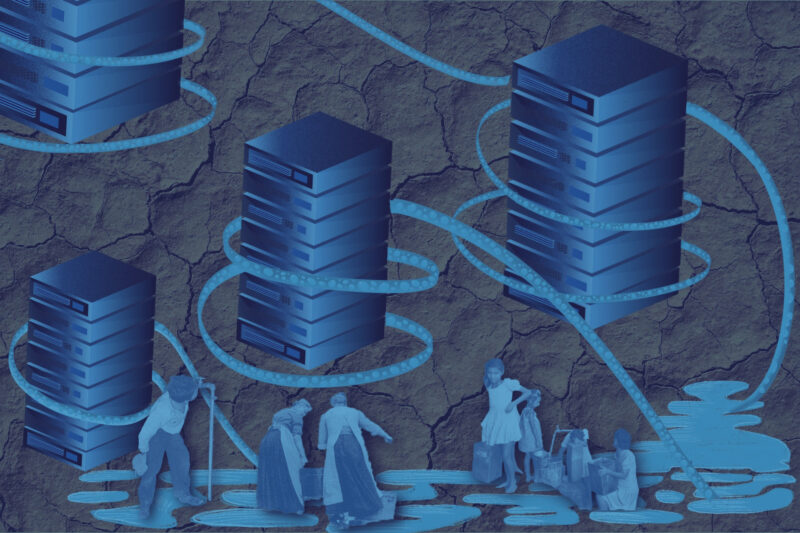
The research conducted for the report Innovation for Whom? highlights how the debate on the impacts of AI infrastructure in the Brazilian Northeast has been made invisible. AI infrastructure is expanding in a region marked by a semi-arid climate and long periods of drought, without a proportional increase in research on its impacts in these places. One example is the municipality of Caucaia, in Ceará, which has drawn particular attention from companies in the sector because of its potential for producing renewable energy (solar and wind), combined with the presence of submarine fiber-optic cables. A reflection of this is the project to build what would be the largest data center in Latin America, which ignores the water crisis faced by local residents [18].
Building data centers in these places reinforces the historical violence faced by vulnerable social groups [19]. Indigenous peoples in Caucaia are already experiencing the effects of the project and “fear that the energy and water consumption required to maintain these structures will worsen the local water crisis” [20]. In Sergipe, other state in northeastern Brazil, another project is expected to consume more electricity than the entire state currently consumes [21].
Without studies examining the effects of data centers in these places, residents and the environment are left adrift. Furthermore, the capacity to develop evidence-based public policies is undermined. “It is therefore clear that the data center projects currently underway in the region lack a guiding scientific basis to support their ecologically oriented development” [22].
References
[1] INSTITUTO DE PESQUISA EM DIREITO E TECNOLOGIA DO RECIFE (IP.rec). Inovação para quem? Os custos socioambientais da IA no Nordeste. Recife: IP.rec, 2026. Available at: https://ip.rec.br/wp-content/uploads/2026/11/INOVACAO-PARA-QUEM.pdf.
[2] CLIMATE JUSTICE ALLIANCE. Data Centers and Artificial Intelligence Infrastructure: A Recipe for Community Harm. [S. l.]: Climate Justice Alliance, [2026?]. Available at: https://climatejusticealliance.org/datacenter/. Accessed on: 11 nov. 2026.
[3] INSTITUTO DE PESQUISA EM DIREITO E TECNOLOGIA DO RECIFE (IP.rec). op. cit.
[4] MARTINS, Laís; CHIAVERINI, Tomás. Moradores se unem para barrar data center do TikTok no Ceará. Intercept Brasil, Sept. 17, 2025. Available at: https://www.intercept.com.br/2025/09/17/moradores-se-mobilizam-contra-data-center-tiktok-ceara/. Accessed on: Nov. 14, 2026.
[5] STERLING, Toby. Ativistas invadem canteiro de obras de data center da Microsoft em Amsterdã. CNN Brasil, Nov. 6, 2026. Available at: https://www.cnnbrasil.com.br/economia/money/inteligencia-artificial/ativistas-invadem-canteiro-de-obras-de-data-center-da-microsoft-em-amsterda/. Accessed on: Nov. 17, 2026.
[6] CHEN, Mike. What Are Small Language Models (SLMs)? How Do They Work? Oracle Brasil, Nov. 5, 2025. Available at: https://www.oracle.com/br/artificial-intelligence/small-language-models/. Accessed on: Nov. 13, 2026.
[7] Wang, F., Zhang, Z., Zhang, X., Wu, Z., Mo, T., Lu, Q., Wang, W., Li, R., Xu, J., Tang, X., He, Q., Y., Huang, M. S., & Wang, S. (2025). A Comprehensive Survey of Small Language Models in the Era of Large Language Models: Techniques, Enhancements, Applications, Collaboration with LLMs, and Trustworthiness. ACM Transactions on Intelligent Systems and Technology, 16, 1-87. https://doi.org/10.1145/3768165.
[8] Ibid.
[9] Wang, F., Lin, M., Y., Liu, H., He, Q., Tang, X., Tang, J., Pei, J., & Wang, S. (2025). A Survey on Small Language Models in the Era of Large Language Models: Architecture, Capabilities, and Trustworthiness. ACM SIGKDD Conference on Knowledge Discovery and Data Mining (KDD), 6173-6183. https://doi.org/10.1145/3711896.3736563
[10] LUNA, Javier Canales. O que é o BERT? Introdução aos modelos BERT. DataCamp, Apr. 23, 2024. Available at: https://www.datacamp.com/pt/blog/what-is-bert-an-intro-to-bert-models. Accessed on: Nov. 12, 2026.
[11] STRUBELL, Emma; GANESH, Ananya; MCCALLUM, Andrew. Energy and Policy Considerations for Deep Learning in NLP. 2019.
[12] GÖRÜCÜ, Sinem; MORAIS, Luiz A.; PANAGIOTIDOU, Georgia. A Critical Analysis of Machine Learning Eco-feedback Tools through the Lens of Sustainable HCI. Proceedings of the 2025 CHI Conference on Human Factors in Computing Systems. 2025. p. 1-18.
[13] JIANG, Peng et al. Preventing the immense increase in the life-cycle energy and carbon footprints of LLM-powered intelligent chatbots. Engineering, v. 40, p. 202-210, 2024.
[14] RÓŻYCKI, Rafał; SOLARSKA, Dorota Agnieszka; WALIGÓRA, Grzegorz. Energy-aware machine learning models—a review of recent techniques and perspectives. Energies, v. 18, n. 11, p. 2810, 2025.
[15] VURUMA, Sai Krishna Revanth et al. From cloud to edge: rethinking generative AI for low-resource design challenges. arXiv preprint arXiv:2402.12702, 2024.
[16] REGILME, Salvador Santino F. Artificial intelligence colonialism: Environmental damage, labor exploitation, and human rights crises in the Global South. SAIS Review of International Affairs, v. 44, n. 2, p. 75-92, 2024.
[17] GÖRÜCÜ, Sinem; MORAIS, Luiz A.; PANAGIOTIDOU, Georgia. op. cit.
[18] INSTITUTO DE PESQUISA EM DIREITO E TECNOLOGIA DO RECIFE (IP.rec). op. cit.
[19] FURTADO, Fabrina. De zonas de sacrifício à luta por justiça ambiental: a cidade é feita pra quem? Coletiva, Recife, n. 24, Feb./May (2019). Available at: https://www.coletiva.org/dossie-direito-a-cidade-n24-artigo-de-zonas-de-sacrificio-a-lutas-por-justica-ambiental.
[20] INSTITUTO DE PESQUISA EM DIREITO E TECNOLOGIA DO RECIFE (IP.rec). op. cit., p. 21.
[21] MARTINS, Laís. CHIAVERINI, Tomás. ‘ÁGUA PARA O POVO, NÃO PARA DATA CENTERS’ Moradores se unem para barrar data center do TikTok no Ceará, Intercept Brasil, 2025. https://www.intercept.com.br/2025/09/17/moradores-se-mobilizam-contra-data-center-tiktok-ceara/
[22] INSTITUTO DE PESQUISA EM DIREITO E TECNOLOGIA DO RECIFE (IP.rec). op. cit., p. 26.
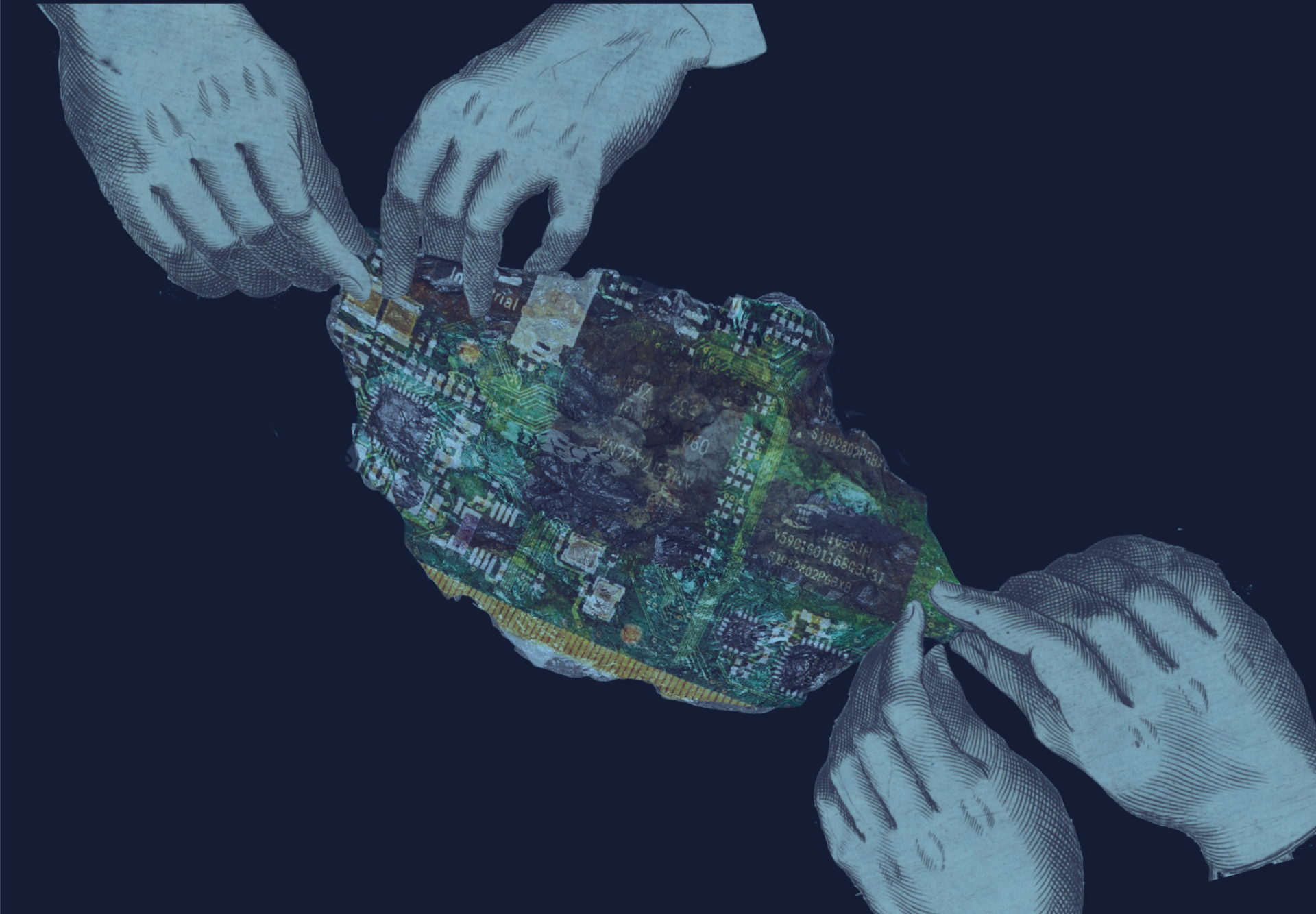
Featured image: Hanna Barakat & Archival Images of AI + AIxDESIGN / https://betterimagesofai.org / https://creativecommons.org/licenses/by/4.0/

Gabriela Nardy
Master’s degree in Social Anthropology from the State University of Campinas (Unicamp), with training in Internet Governance through DiploFoundation’s Advanced Diploma and the Brazilian School of Internet Governance (EGI). For over fifteen years, has been researching and working on issues related to digital rights, gender, access, and connectivity. In recent years, dedicated part of her efforts to understanding how these areas intersect with debates on AI, data centers, and environmental justice.